Powered by Blogger.
Showing posts with label early intervention. Show all posts

The Time We Were Told Our Baby Has Cerebral Palsy

Turns out Little Lola is not as lazy as we once thought, and there are medical reasons behind her immobility. To backtrack, when Lola was 4 months old I noticed her eye was turning irregularly and I mentioned it to Joe. We were mid-screenings with Ryan (pre-autism diagnosis) and Reese was already diagnosed with Duane's Syndrome and wearing glasses. And when I mentioned Lola's eye to Joe he looked at me, let out a heavy sigh and told me to leave it alone, nothing was wrong with her eyes. So I let it go.


Thankfully, I was tied up in evaluations with Ryan when Lola's 9 month well baby visit came around and Joe had to take her for me. Our pediatrician noted that her eye was turning inappropriately (aha!) and recommended we go to see a pediatric opthamologist. At 10 months -- or in August -- we took her to the eye doctor and they noted the strabismus and decided to watch her to see how it continued to develop over the next 6 months.


Right around the time this was all taking place Ryan was being diagnosed with autism and when we were talking to the developmental pediatrician about family history I mentioned the baby's developmental delays. Since there is an increased chance that we would have another child on the spectrum, he asked to see Lola. And we made an appointment for October. 


Meanwhile, in late September, when she was roughly 11 1/2 months old and she still wasn't moving regularly and had literally (the day before her 11th monthday) just started rolling, I called early intervention and had her evaluated. Her scores did not directly qualify her for services (they were borderline), but the evaluation team used professional judgement to qualify her for PT and therapy with a teacher for the visually impaired.


In October we met with the developmental pediatrician who said that cognitively, socially and verbally she was on par with other kids her age, but in terms of gross motor she was obviously behind. He diagnosed her with hypotonia, which is low muscle tone. Essentially her brain does not send signals to her muscles to contract when they are supposed to, or at least not as quickly as they are supposed to. As a result she is very flexible and, therefore, unstable. So this explained a lot of her delays. There is also a school of thought that links eye issues with hypotonia, so there's that theory too.


By November Lola had regularly been receiving therapy for just about a month and we (Joe, her therapists and I) were all pretty convinced that her biggest issue was vision. She's made slow progress, but she is still very cautious and she has issues with depth perception and spatial awareness. Not wanting to wait for February before getting this kid some glasses or an eye patch, I called the opthamologist and asked to come in this month and have her rechecked. This is four months after her last visit, so still a good amount of time to view progress. So we went to her follow up appointment last week, and that is when the shit literally hit the fan.


Now ladies, when I named this blog "It's Always Something" I didn't actually think it would always be something. But jesus freaking christ. It really is.


We get to the pediatric opthamologist last Thursday, with our reports from her EI team in hand, totally prepared to have to get her special glasses or a patch. Instead he evaluates her, determines that she has no vision in her left periphery and an over-tight eye muscle that causes one eye to be higher than the other (this is correctable with surgery later on). And with the loss of left peripheral vision he delivers the following statement WITH A SMILE ON HIS FACE: "Good news, folks! Her loss of vision has nothing to do with her eyesight at all. It's neurological! So you can call your pediatrician and developmental pediatrician and have them coordinate an MRI."


I asked him who I should call first when we left the appointment and he laughed telling me I should wait for his office to transcribe the notes from the appointment and then call. And when I asked how long that would take he told me 7-10 business days. To wait for him to type a letter and mail it, so I could talk to my pediatrician about my 13 month old baby needing an MRI. I don't freaking think so, scooter. And with that I called my pediatrician's office as soon as I got into the car and spoke to one of the nurses. I explained the situation and I explained the opthamologist telling me it would take upwards of two weeks for a letter to get to his office. My pediatrician was out of the office on Thursday and by Friday morning at 8:15 he had already called and told me to come in with Lola for an evaluation.


I love my pediatrician.


So on Friday at 4 p.m. the baby and I went to the doctor and he sat with us and tested her reflexes, asked some questions and told me some of the worst news that I had gotten in a while. We were moving forward with an MRI. They were looking for a fetal infection that may be causing her eye issues or delays, and they were also trying to rule out cerebral palsy.


Cerebral palsy. My heart sank. I had the easiest pregnancy and a complication-free delivery. I've never had any STD's or major health issues. I wasn't even Group B Strep positive with her. And yet, here we were facing some possible horrible outcome.


Usually it takes 3-5 weeks to get in for an MRI and another 4-7 months to be seen by a pediatric neurologist. Our pediatrician had both appointments scheduled for us in less than 72 hours.


I love my pediatrician.


On Wednesday we took Lola to the hospital for her MRI. She was her normal smiling, happy, playful self, even though she had been NPO (without food or drink) for several hours. Her disposition only magnified how horrible the possibilities were. I held my baby while they administered anesthesia, which she didn't fight, even though I could see the fear in her eyes. And then I left the room so they could intubate her and start her IV.


The whole procedure was supposed to take 45 minutes and nearly an hour later a nurse came out to update us that they wanted to take a few more pictures after some of the screens they had gotten and that she'd be in there for another half hour or so. And our hearts sunk again. We thought this can't be good. None of this can be good.


After 90 minutes, we were able to go back and sit with her and wait for her to wake up. She was fussy and disoriented, but she had done great and we were ready to go home. After napping in the car and eating dinner she was back to her laughing, playful self.


Thursday morning our pediatrician called us to let us know that the initial read of the MRI had come in and her MRI was clear. No brain damage, no signs of any trauma. No cerebral palsy. And then we cried. Hot streaming tears of thankfulness and relief and confusion.


Thursday afternoon we went to see the pediatric neurologist. She called our MRI and our visit "unremarkable". She confirmed that the baby has low tone (hypotonia) but said that she sees her catching up between now and her second birthday. She gave the side-eye to the opthamologist's declaration that Lola has a loss of vision in her left periphery (hemianopsia), noting that this is one of the hardest things to diagnose in a child period, let alone diagnose in an infant. She ordered a bloodwork panel to check muscle enzymes and Lola's thyroid, "just to cover our bases", and requested we see a pediatric neuro-opthamologist for a second opinion on her eye issues. The neurologist thinks that the opthamologist made a bad call.


My baby went under anesthesia, was intubated and given an MRI because a doctor made a bad call. And if I wasn't so very, unbelievably thankful that she is healthy I would be incredibly angry that we went through all of this. I keep reminding myself that knowledge is power and it is better to have answers than wonder.


So we'll go see a few more doctors, do a few more tests, keep going with therapy, switch eye doctors (duh) and hope that when she sees the new eye doctor in February that he gives her glasses, which is really probably what she needed all along.

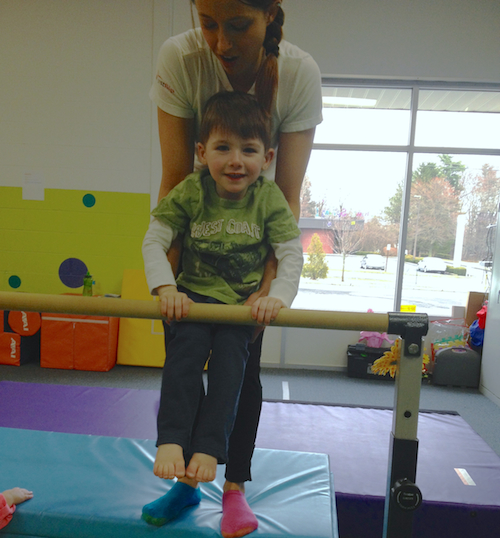
Early Intervention, Part Five

If you missed the first four installments you can find them in this thread.


During Ryan's appointment with the pediatric ENT, an audiologist lent words to what I was already thinking and fearing. In a perfect storm of good timing, we had a private speech therapist start working with him the week after the ENT appointment. Prior to her ever coming into our home, I had discussed Ryan's history, past evaluations and the ENT appointment with her.


She sat with us for almost two hours and observed Ryan playing in our home, interacting with me, etc. and she noticed some things that were just "off" developmentally. From the way that he walks, his need to hold toys in his hand, the lack of eye contact that he was making and the lack of attention he paid her (a stranger in his home), etc. She suggested I call Early Intervention again and ask for another evaluation to be done.


I had given her copies of all of his previous evaluations and she reviewed them and told me that the previous screener had marked off that Ryan was given a multidisciplinary screening (i.e. he had been screened for behaviors, speech, motor skills, etc.) but that only a speech pathologist had actually conducted the screening. In doing so, the speech pathologist was claiming a multidisciplinary evaluation, when in fact it was not. And she told me that a speech pathologist was not  qualified to screen him in these other areas. She told me to ask for a new screening with a full evaluation team and to also ask for a sensory profile specifically, which would measure Ryan's response to specific sensory stimuli.


I credit this private speech therapist with Ryan qualifying for services. Sure, I advocated for him and made the calls and kept fighting for someone to help him. But she gave me the bullet points and the terminology that got Early Intervention to listen to me. And she gave me the confidence to believe that I wasn't just a crazy, overbearing mom looking for something to be wrong with my son.


Also in a perfect storm of good timing, Ryan's 30 month well child fell on the same week as his private speech evaluation. I went over all of the information from the private speech therapist and the audiologist with our pediatrician. Our pediatrician is so wonderful that I could honestly cry when I think of the love I have for that man. He gave me a lot of insight as to what we may be dealing with -- he suggested something called Verbal Apraxia which was later ruled out by our speech therapist and also a diagnosis called PDD-NOS.


PDD-NOS stands for Pervasive Developmental Disorder - Not Otherwise Specified. It is a "mild" form of autism.


I think I need to stop and give that pause. It was at this point in time that I was realizing, maybe for the first time, that my son may have autism.


PDD-NOS is not something that they'll diagnose until he is fully talking. A child with PDD-NOS (or really any form of autism) will not be able to understand the mechanics of objects and instead they will make associations. So, for example, if you ask a child who is developing normally to say the first thing they think of when you say the following words, here's how it would go.


Adult: Pen, Child: Write


When you ask a child with PDD/autism to perform the same activity here's what it would look like.


Adult: Pen, Child: Crayon


This is because their brain doesn't form the same pathways for processing and identifying information. The pathways become very linear. So associations form in place of functions. Until Ryan's conversational language improves we won't really know a lot about what his diagnosis will be. And for now, I am fine without a formal label.


Our third (most recent) evaluation with Early Intervention happened in mid-July. This time there was a whole team that evaluated him. It was *truly* a multidisciplinary core evaluation. He had a certified school psychologist, an occupational therapist, a speech pathologist and a social worker do his evaluation this time. And our Early Intervention case worker attended the evaluation as well. I think she wanted to see what I was making all the fuss about, and even she saw the things in Ryan that I had been expressing for years.


With these evaluations they do not say the children "fail" the test. Instead, they evaluate it by orders of difference. So there is some difference or a definite difference that is noted against standard ideas of development. Ryan was shown to have a "definite difference" in the following areas: Communication, Motor Skills (sensory processing falls into this category), and Social Development.


Here's what this means. He has trouble stringing multiple words together, making certain letter sounds and generally communicating his needs. He has issues with oral sensory processing (needing to put things into his mouth), auditory processing (sometimes not hearing/listening, needing to be touched to get his attention) and registration (tuning into social situations, he actually walks into things sometimes like the wall or a table!). In terms of social development, he was shown to have a clinically significant issue in the areas of withdrawal (meaning he doesn't readily approach adults or kids that he doesn't know to interact with them) and pervasive development problems.


They drew up a 15-page report that was filled with everything I already knew. Yet reading it was like swallowing knives. This final evaluation qualified him for Early Intervention and entitled him to 8 hours of in-home therapy per week with a physical therapist, occupational therapist, speech pathologist and special education teacher. Since the kids participate in several physical activities per week (gymnastics, dance, swimming) we deferred the physical therapist for now, so as not to overwhelm him completely. The rest we are working into our schedule.


This is going to make such a HUGE difference for him, I just know it.


We have an appointment with a developmental pediatrician in June 2014. Yes, they book out over a year in our area. My plan is to bring all of Ry's evals and all of his notes from his EI therapists and see what they think based on where he started and his progress.


For so long I have just been managing the chaos that is my life that even I didn't realize how significant some of Ryan's behaviors have been. Even more than I thought they were. I am thrilled that maybe in the next year, he will put down a train and walk to the door and put on his shoes. Or not hit me. Or not have an outburst when I take a car out of his hand to get his shirt off.


Small things.


He is such a wonderful, loving little boy. But it almost feels like his mind is trapped sometimes and he's frustrated. Other times he's just triggered because we took away a security object or lord knows what.


I do not think Ry has autism. Not because I am in denial about it, but because I think we are dealing with a sensory disorder and I can't tell if the sensory stuff is magnifying his speech delay. Or if the speech delay is magnifying the sensory stuff. Only time will tell.


What I do know is that I have a little man who hugs me so tight for no reason at all. That climbs in my lap just to hold my hand. That looks me dead in the eyes before kissing me with the fullest lips. He hugs his sisters readily. Rocks the baby often. Laughs from the bottom of his soul.


He is one of the most beautiful people I have ever known. From the second that he left my body and I waited for his cry and wondered out loud if he was real, if he was mine, I have been in a kind of love I never dreamed possible. I don't know what lies ahead of us, but what I do know is that we're strong enough to get to the other side. And that I am lucky that I get to grow through this experience with him.

Early Intervention, Part Four

If you missed the first three installments, you can find them here, here and here.


Ryan was tested for early intervention for the second time at 28 months old after a PEDS screening at his preschool. Since we had already gone through a specific agency with his first screening at 15 months and they seemed competent, we went through them again for this second screening. Ryan did not qualify for services, again.


At the urging of the speech pathologist who had conducted the second screening, we scheduled an appointment with a pediatric ENT to have Ryan’s tonsils and adenoids evaluated to see if they were enlarged and possibly contributing to his speech delays. The recommendation was to then have him screened again after 30 months for qualification into an early intervention program that is managed by our school district, as opposed to the county, and run by a group called the Committee on Preschool Education (CPSE). The idea being that if his adenoids or tonsils were the issue, he would have surgery and then we could see if his speech improved. Or if he did not have an issue with his tonsils or adenoids and still didn't make progress, he'd be more likely to qualify after he was 30 months old.


In the meantime, I hired a private speech therapist to come to our home. This was only marginally more expensive than my insurance copay. This also avoided the babysitter/childcare/managing schedules for three kids dance that came with going to a private agency wherein you have to bring your child to an office for services.


Ryan’s appointment with the pediatric ENT was on June 17. They looked at his tonsils and adenoids with the mouth flashlight that pediatricians use and also with a camera that was put down his nasal passage. As a sidenote to this, our insurance company considered this “surgery” and we were charged a ridiculous amount for this procedure out of pocket because we haven’t met our surgical deductible for the year. Insurance reform is so badly needed, but I digress.


Ryan was also seen by an audiologist (which is a medical doctor for hearing, please forgive me if you knew that, I had no idea what the hell an audiologist was before this appointment). They put Ryan and I in a sound booth and she sat behind a semi-opaque mirror and played noises in various speakers placed around the room. The point of which was to get him to turn toward the noise, no matter how soft it was. It was hard not to turn to the noise with him sitting on my lap, thereby tipping him off to something inadvertently. It was even harder to sit with him there on my lap and hear the noises and anticipate him turning, and know that there were noises that he was obviously missing.


After being screened in the booth, the audiologist tried to conduct an advanced hearing test on him by sticking these rubber things in his ears that would play sounds. Ryan would not let her anywhere near him or his face and his behavior was some of the more outlandish that I had ever seen.


I was told that Ryan's hearing is on the lowest end of "normal" and that his ear drums were retracted, which is a sign that they were either recently filled with fluid or they were about to be filled with fluid. The fluid is what causes kids to have ear infections. Now, Ry has never had ear infections. But apparently you can have ear fluid without it progressing to an ear infection wherein you get very sick, have a fever, etc. I had no idea.


They suggested we come back in three months -- October -- to have his ears looked at again. In the meantime the audiologist made some comment about how they would be monitoring him for some developmental things that she noted. I kept pushing her to tell me what she had seen, but she wouldn't give me more information other than to say that they would be monitoring him. Having been a teacher I knew in my heart what she was hinting at and it lit a fire under my ass so big that I went right into action as soon as we got back into the car.


I called the Early Intervention caseworker and I think she was less than thrilled to hear from me again. I think she thought I was crazy. I told her if they missed diagnosing my son with autism for budgetary reasons that this wouldn't be the last angry phone call I made to her office (!) and what do you know? She scheduled a new evaluation for Ryan.


* p.s. we are still successfully paci-free, and it has helped with his clarity of speech immensely. Some of these are just old pictures. 

Early Intervention, Part 3

When I started writing about our adventures in Early Intervention, I never anticipated it would become the next Star Wars Trilogy. But these things sort of happen when it comes to your kids, their well-being, and your need as a parent to advocate for them. So here we are, 13 months later and the saga continues. If you missed the first two installments, you can find them here and here.


Ryan was tested for Early Intervention services again last Monday. He is 28 months old. The range of normal, I believe I was told, is 85-101 and he tested in the 90's for everything except the category regarding pathways to independence. In that category he scored an 83 because he doesn't use pronouns, talk about himself in the third person, or eat well. That one made me snicker. My picky eater failed a speech test because he doesn't eat. But there are no categories at his age that grade him for not being able to string multiple words together to form a cohesive anything or categories which outline being able to be understood when you talk to someone other than your mom. Whisky. Tango. Foxtrot.


But I digress. So, of course, he didn't qualify for services. Again. And I was told had he been 30 months old that the standards would have been different and he might have qualified then. With that I am pretty much over State funded speech intervention for my kid. I have insurance, I'll pay for it out of pocket. End of story. Or so I thought.


After Ryan's evaluation the speech pathologist and psychologist sat with me to discuss their reports and how he scored and gave me information about next steps and other ages at which he can be tested to try to get him qualified for services. They told me before I do anything else I need to make an appointment with our pediatrician because Ryan is nasally and they want me to verify that his adenoids or tonsils aren't enlarged or malformed.


Now, truth be told, my kid has a funny voice and I kind of just chalked it up to the way he talked. But he does weird things like hold his breath for prolonged periods and then just exhale all at once. He's a mouth breather. And he puts everything in is mouth. I even have pictures of the kid laying flat on the floor deep throating a door stop. Lord help me. So perhaps he just has some idiosyncrasies. But there's a chance he has some other more physiological issues too that are preventing him from correctly forming words.


So we made an appointment in early June to see our pediatrician. From there the recommendation was to wait until July, when the twins are 30 months old, to have Ryan screened again through private practice and get him into speech therapy. While this was a lot to absorb, I was okay with the directives we were given.


Fast forward to Wednesday afternoon when I got a call from our case worker who has been handling Ryan's file for the last year plus. She urged me not to leave the testing of his adenoids and tonsils up to the pediatrician. And then also gave me information about when and how to contact our school district to have Ryan transitioned from private therapy to therapy provided for the school district through the Committee on Preschool Special Education. From July through November he'll be working with a private speech therapist, and by November he should qualify for public services. I don't really care if we pay or our tax dollars pay at this point, I just want my little boy to stop hitting himself, me, walls, everything because he can't talk. It is so frustrating for all of us.


I kept his appointment with the pediatrician, but also made an appointment with a pediatric ENT. As nice as it would be to blame his adenoids or tonsils on the reasons he isn't speaking and isn't speaking well, I really hope that they are normal. The idea of having him go through any kind of surgery makes me feel sick.


Early Intervention, Take Two

The twins were given screenings for early intervention at their preschool last week. Once again, Ryan was flagged for further testing. This is almost exactly a year after the last time he was flagged for possibly needing services. In New York State it is very hard to qualify for services under the age of two. I thought for sure Ry would qualify last time, because he was fifteen months old and he literally had no sounds. No babbling, no mumumum, dadada. Nothing, nada, zilch. The evaluator came and did her thing, and we came to find out that receiving speech therapy actually has less to do with not speaking and a whole lot to do with social and cognitive skills.


In his full report he was evaluated on problem solving, personal-social skills, gross development, fine motor development and communication.

Ry's ability to place objects into containers, scribble on paper, dump objects out of a box and play with puzzles put him on par with his peers in terms of problem solving and cognitive development.


Fast forward a year, and I now have an (almost) 28 month old who does not have the ability to string words together and who does not speak clearly enough for others to understand him. Even Joe and I have difficulty deciphering Ryan-speak, at times. He is a very intuitive, compassionate and smart little boy. But his enunciation and clarity of speech are majorly lacking. And his overall verbal development is behind.


As a twin parent you know you aren't supposed to compare your kids. But his sister is way ahead of the curve with language, and it only serves as a mechanism to underscore how behind he is with speech. To add insult to injury, I have started to see this create social issues between the two of them. For example, people will say "Why does Ryan need to talk? Reese does all the talking for him?" or "Of course Ryan doesn't talk, his sister doesn't let him get a word in edgewise."


Friends and family will try to work with Ryan or talk to him ("what does a cow say?" "what is this a picture of?") and Reese will shout the answer from across the room. Then she is shut down with things like "not you, your brother". Of course she is going to shout the answer because she is a proud and precocious two year old. (Doesn't that describe ALL two year olds?)


Balancing the two of them, and making sure each gets their needs met, while also supporting their development -- both social and intellectual -- has been a delicate issue. I know it is not one that is limited to me as a multiples mother.


We had our prescreening meeting with our family's County representative yesterday and we weren't given a lot of hope in terms of Ryan meeting the requirements to receive services. Apparently, at age two, they do not evaluate receptive and expressive language separately from one another. Because he has more than 50 words (wherein animal noises count) and he can follow directions, he may just be "overqualified". Even though he cannot communicate himself and this creates atypical social behavior (frustrated hitting of himself, walls, tables, and other inanimate objects).


Our actual screening is on Monday. He will be evaluated by a psychologist and speech therapist. I am hoping beyond hope that he qualifies for EI, I'd love to see him make strides this summer and really come into his own. If he doesn't qualify for our County program, we will be going through a private agency to get him support. I am only sorry I didn't advocate for him and go the private route sooner. I honestly thought that... boys develop slower, he was still young, his sister was just advanced, etc.


At any rate, he'll get the help and support he needs now. I can't wait to hear him talking up a storm. Although I will say, I'll miss the Ryan speak. There is something uniquely endearing about the way he creates words. And while it is hard for others to understand him, I love that I do.


Early Intervention

My friend Heather recently wrote a post about the possibility of her (ridiculously cute) daughter undergoing an EI evaluation and since that seems to be a hot topic among those of us with 12-24 month olds I figured I should write about Ryan's recent evaluation and our experience. It is hard to be the momma. I find myself always worrying about whether the kids are meeting milestones or falling behind, and I know I'm not alone in that worry.


Ryan was actually tested early, even by EI standards, after I spoke to our pediatrician at his 15 month well baby. At that point Ry had literally NO WORDS. Not even mama or dada. He grunted and groaned and made high and low pitched squeals. He did manage to say mumumumum, but it was more of a rambling babble and not even remotely directed at me. What I found to be the main issue though was that his lack of language acquisition and his inability to express himself was manifesting into negative behaviors like hitting, kicking and biting. 


When my pedi heard that he had no verbal language and he was acting out he suggested that we get in for an evaluation, but warned us that it is hard to qualify for services and that Ry may not meet the requirements. Especially given his age.


In our state and county, early intervention is paid for by the state. I think in some ways this makes it harder to qualify for services since the budgets are already stretched quite thin. But it does allow access to programming and help for children of all income families. 


I was given a number for a state agency and I was assigned a case worker. About a week after I contacted her office she received the prescription for the evaluation from my pediatrician. But by then we had already set up our initial meeting to review paperwork and ask/answer questions. The case worker came to our house to meet me and she was lovely. She took a lot of time to explain the process to me and answer my questions and then she allowed me to select a local agency who would send over a speech pathologist to come and evaluate Ryan in our home. 


From the initial phone call to Ryan's in-home evaluation was a period of less than three weeks. The evaluation was very underwhelming. The speech pathologist played with Ryan using toys already in our living room as well as toys she had brought. I say it was underwhelming because I expected him to have to take some sort of physical challenge test or jump through hoops or something. But it was just the three of us sitting in the living room playing with toys while I answered her questions.


Even though Ryan was completely lacking in expressive vocabulary at the time of his evaluation he did not qualify for services, which wasn't surprising after I read the full report. He was evaluated at 15 months and 25 days old. In his full report he was evaluated on problem solving, personal-social skills, gross development, fine motor development and communication. 


Ry's ability to place objects into containers, scribble on paper, dump objects out of a box and play with puzzles earned him a gold star in problem solving and cognitive development. All joking aside, I didn't even realize these were qualifications for verbal speech development. 


His ability to use a spoon at mealtime, help get himself dressed (i.e. lift up his arms so you can take off his shirt, etc.), parallel play and pull away from me to go play with a toy he wants showed he had developed personal-social skills. He also demonstrating this by showing a close bond with me and by offering the speech pathologist toys to play with. So adorable, by the way.


Walking, climbing on furniture, and squatting to play qualified him the area of gross motor development. And turning the pages of a book, throwing a ball, stacking toys, completing puzzles and feeding a baby doll using a spoon qualified him in the area of fine motor development.


In terms of communication there are two evaluation areas -- receptive and expressive language. Receptive language qualifiers were his ability to point to pictures in books, locate objects/toys upon request, follow simple instructions (i.e. give monkey a kiss) and respond to his name being called. Expressive language was the area in which I expressed the most concern (and frankly, it was the only area that I thought would be a focus for a speech evaluation...). But he passed in this category based on his ability to use low and high pitches and attempting to sing Old MacDonald ("e-i-e-i-o"). 


The recommendation is to reevaluate him at 21 months if he doesn't have true words or the ability to label people/objects; use b and m sounds paired with vowels (i.e. mama, baba, ball, etc.); imitate simple words; and produce a variety consonant-vowel combinations. 


Ryan is now 17 months and 7 days old and he has two words, neither of which are used regularly -- shisha (sister) and (isch) fish. He can say mumumum and dadada. But doesn't direct either at Joe or I. After the evaluation, I feel kind of relaxed about this all. He was a late sitter upper, a late crawler, a late walker (at nearly 16 months) so the fact that he's a late talker is not a shocker. We took the advice of the evaluator and started the kids on sign language. I bought them the four Baby Signing Times DVDs. Ironically it's caused a small language explosion in Reese. But both babies have significantly benefitted from learning signs as a mechanism for communication. Ry is very good at signing more, eat (and tapping you and then signing eat to let you know he needs a snack LOL), all done, milk, balloon, ball and lots of other helpful and cute stuff. 


We're coming up on our 18 month well baby and I don't even plan on bringing up his language. And frankly, even if we haven't progressed at 21 months I probably won't bring it up again then. If by 24 months he still seems to be stuck I'll push for another evaluation. But I really think he's just a late bloomer. Anyway, the process was really enlightening and I'm glad we underwent the process. I'm happy to answer questions for anyone heading in that direction. Hopefully our experience can help someone else questioning their own child's verbal development.


Popular Posts

My Ping in TotalPing.com